|
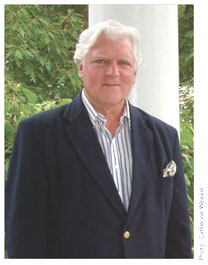
Over the last several decades he has worked on the environmental implications of public policy choices, and he is principal author of the recent work, Environmental Decline and Public Policy: Pattern, Trend and Prospect (1992), based upon testimony he presented to the United States Senate in support of legislation to limit carbon emissions in September of 1988. Most recently
research concentrates upon belief systems within cultures
and how core cultural beliefs can either facilitate change
or block change over time.
During the 1990s Dr. Weiskel founded and directed the Harvard Seminar on Environmental Values at the Harvard Divinity School, the first ever inter-departmental and inter-School effort at Harvard to explore the values and beliefs that are commonly built into the disciplines and perspectives in the Harvard academic environment.
In particular, he has examined how dominant belief systems serve
to impede or enable different cultures to perceive the changing
environmental challenges that confront us all as a human family.
To pursue this work he co-founded The
Climate Talks Project in 2001 along with Professor
William Moomaw of the Fletcher School at Tufts University. This
group has convened scholars, business leaders, NGO activists,
journalists and concerned citizens to discuss effective means
of mobilizing civil society to respond to the evolving global
climate crisis.
From 2001 until 2017, Dr. Weiskel taught 45 semester courses for over seventeen years on campus at Harvard and globally for online students from around the world on the topics of global
climate change, environmental
ethics and environmental
justice as part of the Sustainability Degree program through Harvard's
Extension
School. These courses focused upon the ideological and conceptual
barriers to transforming our current industrial culture based
upon metaphors of continuous consumption and perpetual growth
into new cultural forms based instead upon metaphors of stability,
justice and sustainability.
Professor Moomaw and Dr. Weiskel worked together throughout these 45 semesters of course work to elaborate for their students at Harvard and throughout the world across the Internet the cultural values and practical mechanisms for implementing a trans-national, global strategy of restorative development.
In addition, from 2008 to 2013 Dr. Weiskel taught an annual "Global Climate Update" course for graduate students and public health officials at The Cyprus International Institute (CII) for the Environment and Public Health as part of an advanced degree program established by the Cyprus University of Technology (CUT) in cooperation with the Harvard School of Public Health.
Dr. Weiskel was encouraged by the life-long example of Yale's Chaplin and educator, Bill Coffin on the one hand and outraged at the same time by the selective and misleading information provided around the world by his college classmate, Daniel Yergin (Yale, '68). While teaching at the Harvard Kennedy School of Government Dr. Yergin collaborated with colleagues at the Harvard Business School and launched the Cambridge Energy Research Associates (CERA - later S&P Global) to advise paying clients around the world to maximize their profits by selling terrestrial carbon with the help of his sophistocated market analysis.
To counteract the pervasive influence of this ecologically devastating advice Dr. Weiskel created the Cambridge Climate Research Associates (CCRA). The goal of the CCRA has been to enable scholars, students and citizens throughout the world to recognize the disastrous impact of continuing to burn, release and frack for fossil fuels. CCRA provides historical documentation and current evidence to support an alternate understanding of why renewable fuel sources are the only means of assuring human survival in Earth's finite ecosystem.
Inspired further by fellow New Hampshire Rhodes Scholar, Robert Reich (New Hampshire & University 1968) -- whose public service, academic research and trenchant analysis offers a model for timely and courageous civic action -- Dr. Weiskel also created Food-Matters.TV, Rhodes-Scholars.TV, Global Climate Change & Africa and Transition-Studies to provide current news and information to concerned global citizens working in the realm of environmental science, environmental ethics and the elaborating the conditions required for free and objective inquiry into the environmental future facing the human community.
Through a series of video weblogs, Weiskel has developed "Conversations in Transition Studies"-- as part of the Citizen-Science Online Learning Initiative (CSOLI). This initiative provides discussion materials through Google & YouTube for public affairs groups and concerned citizens everywhere who are seeking to organize the kinds of deliberate transitions we will all need to make if our societies are going to be able to survive forthcoming changes in our global climate.
Through these online facilities and customized training programs Dr. Weiskel has consulted
with individuals, groups and institutions to create on-site and online training programs for schools, universities, corporations, civic groups, municipalities, regional and national governments. The goal is to assist these organizations
in analyzing the
climate impact of global carbon consumption and help them
envision
the necessary transformations we must all now undertake
to enable
the human community to move to a post carbon-fueled world. |